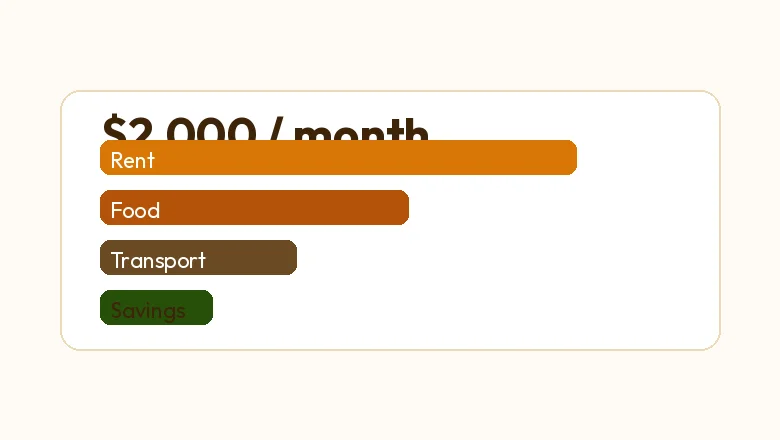
Yes, you can budget on $2,000 a month. Keep housing under $700, groceries around $200, transportation under $200, and save at least $100–$200 every month. The key is tracking every dollar and cutting fixed costs where possible. Use zero-based budgeting — give every dollar a job before the month begins.
How to Budget on $2,000 a Month — First: Is This Take-Home or Gross?
This matters more than people realize. $2,000 take-home (after taxes) is very different from $2,000 gross income.
- If $2,000 is your take-home pay — this guide applies directly to you
- If $2,000 is your gross pay — subtract roughly 15–25% for taxes, meaning you actually have $1,500–$1,700 to work with
For this guide, we'll assume $2,000 is your take-home pay — the real number that hits your bank account.
Reality check: The average American household spends $6,545 per month, according to the 2024 Consumer Expenditure Survey from the U.S. Bureau of Labor Statistics. At $2,000 a month, you're working with roughly one-third of the national average. That means trade-offs are unavoidable — but not impossible.
Step 1: Understand Your Fixed Expenses First
Fixed expenses are bills that don't change month to month. List these first because you have little immediate control over them.
Common fixed expenses on a $2,000/month budget:
- Rent or mortgage: $600–$900 (ideally under $700)
- Car insurance: $80–$150
- Car payment: $0–$350 (no car payment is ideal)
- Phone bill: $20–$80
- Internet: $40–$70
- Health insurance: $0–$300 (often $0 if covered through employer)
If your fixed expenses exceed $1,500: No budgeting trick will fix a structural problem. You either need to reduce a fixed cost (move to cheaper housing, get a roommate, refinance a car loan) or increase income. Cutting your Netflix subscription won't save a budget that's already underwater.
Step 2: Build Your Real $2,000 Monthly Budget
Here's a realistic breakdown for a single person living on $2,000 a month. Adjust the numbers based on your actual situation:
| Category | Amount | % of Income |
|---|---|---|
| NEEDS | ||
| Rent (shared or studio) | $650 | 32.5% |
| Groceries | $200 | 10% |
| Transportation (gas or transit) | $150 | 7.5% |
| Utilities (electric, water) | $80 | 4% |
| Phone | $35 | 1.75% |
| Internet | $50 | 2.5% |
| Health insurance / copays | $60 | 3% |
| Total Needs | $1,225 | 61.25% |
| WANTS | ||
| Dining out / takeout | $100 | 5% |
| Entertainment | $50 | 2.5% |
| Streaming subscriptions | $20 | 1% |
| Clothing / personal care | $80 | 4% |
| Total Wants | $250 | 12.5% |
| SAVINGS & BUFFER | ||
| Emergency fund savings | $175 | 8.75% |
| Debt extra payment | $200 | 10% |
| Irregular expenses buffer | $150 | 7.5% |
| Total Savings | $525 | 26.25% |
| TOTAL | $2,000 | 100% |
Note on irregular expenses: That $150/month buffer covers things like car registration, doctor copays, holiday gifts, and haircuts. These feel like "surprises" — but they're predictable. Budget for them in advance and they stop being emergencies.
Step 3: Apply a Budgeting Method That Actually Works
The most common advice is the 50/30/20 rule: 50% needs, 30% wants, 20% savings. On $2,000 a month, that's:
- Needs: $1,000
- Wants: $600
- Savings: $400
The problem? In most U.S. cities in 2026, rent alone consumes 30–45% of a $2,000 income. The 50/30/20 rule breaks down immediately for most people at this income level.
What actually works: Zero-based budgeting.
Zero-based budgeting means you assign every dollar a specific job before the month starts, until you reach zero. You don't have $100 sitting in checking "for whatever" — that $100 is assigned to your emergency fund, your grocery budget, or next month's car registration.
This method works for low incomes because it forces complete intentionality. Nothing slips through the cracks.
Step 4: Track Every Dollar for 30 Days
A budget on paper means nothing if you don't track actual spending. Your first month, write down every purchase — even the $2 coffee.
Free tools that work:
- EveryDollar (free version) — built around zero-based budgeting
- YNAB (free 34-day trial) — excellent for zero-based method
- Google Sheets — a simple spreadsheet works fine if you'll actually use it
- Cash envelopes — old school but extremely effective for controlling variable spending
After 30 days of tracking, you'll know exactly where your money goes — and where it's been leaking.
Step 5: The Five Easiest Places to Cut Spending
If your $2,000 budget isn't balancing, here's where to look first:
- Subscriptions you forgot about. The average American pays for 3-4 subscriptions they barely use. Log into your bank statement and cancel anything you haven't used in 30 days. Potential savings: $20–$80/month.
- Your phone bill. Carriers like Mint Mobile, Visible, and Consumer Cellular offer the same coverage as major carriers for $20–$35/month. Switching from a $80/month plan saves $540 per year.
- Grocery waste. Americans throw away an estimated $1,200–$1,500 in food per year. Meal planning before you shop — and buying only what's on your list — cuts this dramatically. Potential savings: $50–$100/month.
- Dining out frequency. Cooking one more meal at home per week instead of ordering out typically saves $40–$80/month without feeling deprived.
- Car insurance. Call your current insurer and ask about discounts, then get quotes from 2-3 competitors. Most people can reduce premiums by $20–$60/month without changing their coverage.
Step 6: Build Savings Even on $2,000 a Month
According to the Federal Reserve's 2024 Report on Economic Well-Being, 37% of Americans could not cover a $400 emergency with cash. Even a small emergency fund changes this entirely.
Your savings priority order on $2,000/month:
- $1,000 emergency fund first. At $175/month, you reach this in about 6 months. This one fund prevents most financial crises from becoming disasters.
- High-interest debt next. Any credit card debt above 15% APR should be attacked aggressively after your starter emergency fund is in place.
- Build emergency fund to 3 months of expenses (~$6,000 on a $2,000/month budget).
- Start retirement savings. Even $25–$50/month into a Roth IRA is a meaningful start. Time matters more than amount when investing for retirement.
Automate savings on payday. Set up an automatic transfer to savings the same day your paycheck lands. What you don't see, you don't spend. This single habit is more powerful than any budgeting app.
Common Mistakes When Budgeting on $2,000 a Month
- Budgeting perfectly in January, then giving up by March. A budget isn't pass/fail. If you overspend on groceries this week, adjust another category — don't scrap the whole plan.
- Forgetting irregular expenses. Car registration, dentist visits, seasonal clothing — budget for these monthly by dividing the annual cost by 12 and setting that money aside.
- Not accounting for income variability. If your income fluctuates, always budget based on your lowest expected month. Windfalls are bonuses, not income.
- Treating a tight budget as permanent. A $2,000/month budget is a starting point. Use it to build stability while actively working to increase income — side hustles, skill development, job searching.
Frequently Asked Questions
Can you live on $2,000 a month?
Yes, but it depends heavily on where you live. In low cost-of-living states like West Virginia (average monthly expenses ~$1,485) or Arkansas (~$1,534), $2,000 a month provides real breathing room. In California, New York, or Hawaii — where average monthly expenses exceed $2,500 — it requires shared housing and significant trade-offs.
How much should rent be on a $2,000 a month income?
Financial experts recommend spending no more than 30% of take-home pay on rent — that's $600 on a $2,000 income. In today's rental market, this usually means sharing an apartment with roommates or living in a lower cost area. Spending more than $800/month on rent at this income level makes saving almost impossible.
Can you save money on $2,000 a month?
Yes. Saving $100–$200/month consistently builds $1,200–$2,400 per year. The key is to automate savings on payday before you spend anything else. Start with a $1,000 emergency fund as your first milestone — it takes about 5–6 months at $175–$200/month savings.
What is the best budgeting method for low income?
Zero-based budgeting works best. You assign every dollar a specific job until you reach zero at the end of the month. This forces intentionality and prevents money from disappearing into vague spending. Start with a simple spreadsheet or the free version of EveryDollar.
Is $2,000 a month enough for a single person?
For a single person in a low cost-of-living area with shared housing, $2,000 a month is workable. In expensive cities it becomes very difficult without subsidized housing or a roommate. The biggest levers are rent and transportation — keep both as low as possible.
Sources & References
- U.S. Bureau of Labor Statistics — 2024 Consumer Expenditure Survey, released December 2025
- Federal Reserve — 2024 Report on Economic Well-Being of U.S. Households (SHED)
- Consumer Financial Protection Bureau — consumerfinance.gov
- doxo — 2025 US Household Bill Pay Report (state-level expense data)